TEXTUAL forms:
scores + poetics
(performative writing)
40 days in the desert / 40 nights in the flood
Book (180 pages)
This collection proposes a different kind of iconography : one that, with only words, conjures the presence and environment of the holy figure, and invites them to live in the body of the reader. There are no visual representations here. Jesus and Mary Magdalene (the main 'characters') remain amorphous, unfixed, arising through sensation rather than depiction. The icon is not painted, but rather provoked.
The work comprises two cycles. 40 Days in the Desert was written during Lent 2025 across forty days of complete fasting. One text was written each morning in conversation with Jesus, in the imagination of joining him in the wilderness. The desert writings attempt to build proximity with the most commonly objectified human figure in history: Jesus; to connect with him not as scripture delivers, but as complex, breathing oddity, real enough to sweat and sleep and doubt beside. And because he met the Stranger there in his fast, this daily performative practice demanded bewilderment also in the artist: to enter the interior wilderness - perplexity - held open as faith's condition rather than its enemy.

40 Nights in the Flood began at Easter, written as Mary Magdalene in the forty nights between Jesus’ resurrection and ascension. After the encounter with her risen teacher, during which she was the first witness (and perhaps the only to receive a full transmission of the miracle), she promptly went to tell the other disciples, who mocked and rejected her claim. After which point, in the canonical scripture - there is no word of her whereabouts after. These texts present a speculative imagining that she, living now in hiding from the Romans and in exile from the disciples, visited the mikveh (the holy bath) nightly and alone, to integrate the transmission in her spirit and body.
Indeed, little is known or written of both of these figures during their respective initiations. Where the desert was disciplined and ascetic, the flood was bodily, overwhelming and immersive. The flood writing was preceded by hours of lucid dreaming, cold water immersion, which assisted in dissolving the boundary between the writer and figure.
The texts function as invocative prayer: not petition directed outward towards an elsewhere, but a calling-in of divine presence through the sensory body. This process was a private theopoetic liturgy - the creation of God through imaginary and imaginal activation - and also a kind of erotic theology that understands desire itself as a primary mode of encounter with the sacred.
These are hybrid texts: both prayer and poem, scripture and dream. They are intended to be simultaneously read and heard, as liturgical texts often are. They do not require comprehension in the usual sense. The invitation is to let the words permeate, to allow sensation to arise. The work wants to be felt rather than understood. To be lived - until the figures become real in the body, where then the icon arises from within.
Artist ≠ Monk
Book (forthcoming)
Monks and artists share an unlikely kinship: both have chosen to organize life around a point-of-reverence, departing from conventionality to give form to something they can approach but never fully possess. Both cultivate disciplines of attention. Both face the problem of sustaining devotion to something that removes them from the shared, conventional world (or at least inhabiting it in the normalized sense). Both must negotiate the relationship between solitary practice and communal form. And both must face their daily lives and humanness despite cultivating expanded visions and preoccupations.
But the artist is not the monk. The frames diverge - in their relationship to ego, to transgression, to the body, to failure, to the market, to the sacred itself.
This book emerges from six years of hosting artists at La SOURCE, an international artistic research center engaged in love-studies through integrative inquiry and creative practice. Over 130 artists have passed through, each bringing their own relationship to longing, to practice, to orientation in work. The central question that emerged across these years: How does one build a devoted, yet integrated, life?
The book weaves essays, interview transcripts, evidentiary materials, and process residue from La SOURCE's first six years; tracing what was witnessed, what was lived, what was made, and what remains.
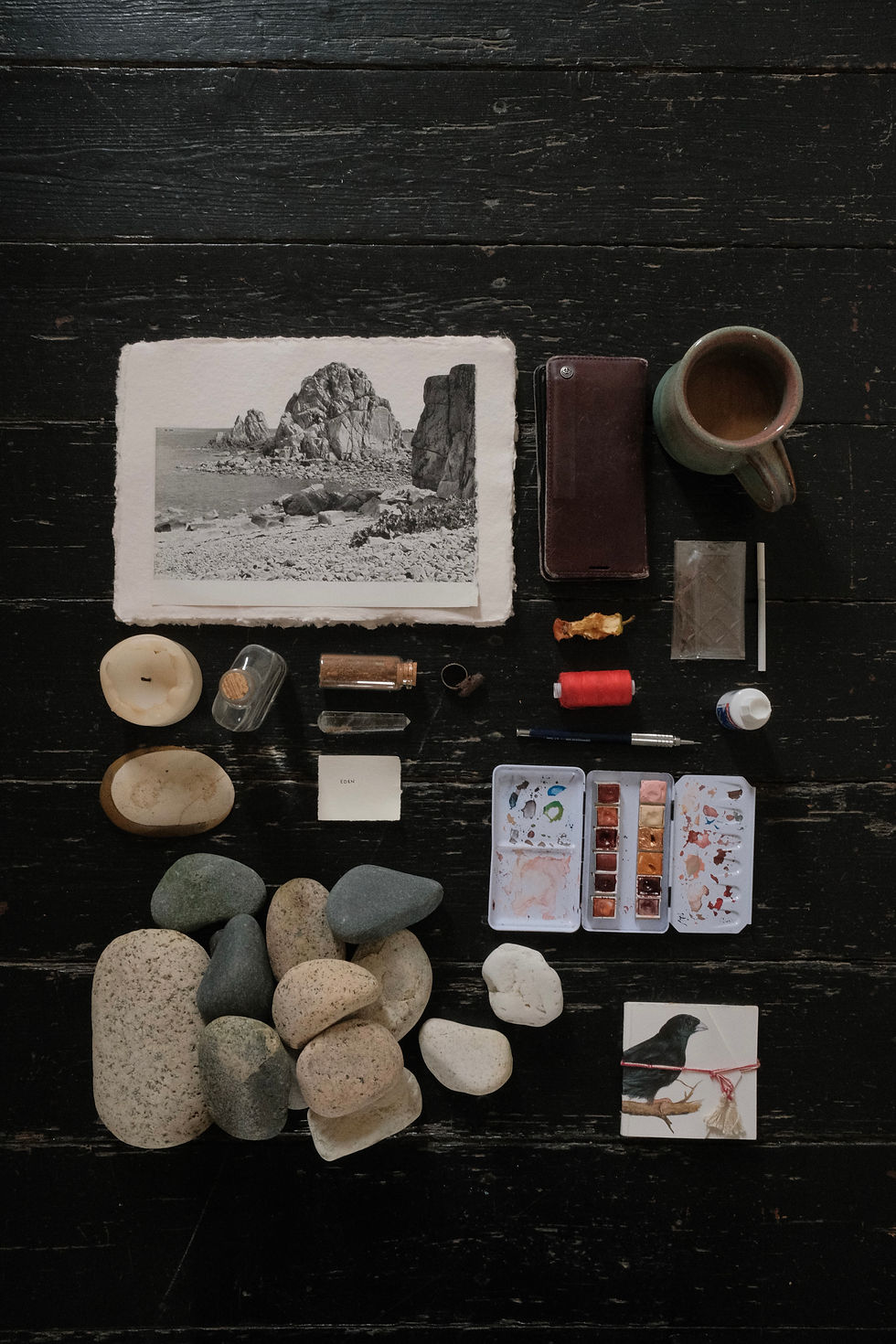


Artists were asked to make a self-portrait of their practice by assembling their tools as archeological objects. Photos by project assistant, Melanie Ganino.
The 4 Temples
The Four Temples Book (in development)
If theology is a creative discipline, then the way we imagine God shapes what God becomes - and what we become in relation.
This book proposes a framework for approaching faith not through doctrine but through orientation: four distinct attitudes toward the sacred, each with its own architecture of encounter, its own gifts, its own dangers.
The Temple of Something.
The Temple of Everything.
The Temple of Anything.
The Temple of Nothing-in-Particular.
These are not religions. They are not belief systems. They are postures — ways of positioning oneself toward what exceeds understanding. Every tradition contains all four; most practitioners settle into one and forget the others exist.
The book draws on theopoetics, queer theology, phenomenology, and two decades of creative practice at the edges of art and spiritual accompaniment. It offers the Four Temples as a tool for those seeking non-dogmatic pathways to meaning-making — and as an argument for prayer as artistic medium, theology as perpetual composition, and the queering of God as devotional practice.
This project will be pursued in the context of a practice-led doctoral research commencing fall 2026.

ECTOPIA
Ectopia: A Travel Guide to Displacement
Performative and Evidentiary Monograph
(352 pages)
This publication, a collection of records from an artistic research entitled: the body in control of losing control; in addition to the experiments conducted by the artist, the collection includes invited contributions from 23 interdisciplinary scholars, clinicians, writers and artists.
This book playfully chronicles the invented concept of Ectopianism: the use of the body as a vehicle for the displacement of self through active engagement with fear and the unknown.
Project hosted by the Advanced Performance and Scenography Studies (a.pass) - an artistic research container, formerly attached to The Royal Institute for Theatre, Cinema and Sound, Brussels.
