INTIMATE forms:
propositions for an audience of one
(relational practice)
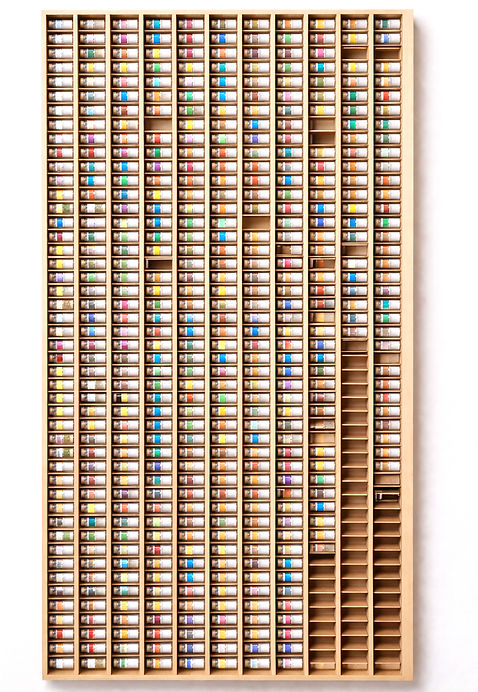
Dust: An Apothecary
or God's Organ
Work in progress (2024 - )
A thousand tinctures, each distilled from dirt collected at a site of a seemingly mundane human experience (a mother hugging her child before taking a flight, a person crying in a grocery aisle, a man adjusting another's collar, a woman removing a dead bird from the sidewalk with surprising tenderness, the scene of a car accident in which no one was seriously hurt, etc.).
The number 1000 references the quantity in the Abrahamic imagination where human counting yields to the divine scale of imagining. “For a thousand years in your sight are like a day that has just gone by.” (Psalm 90:4) This same frame of belief holds humans as created from dust, and with a destiny to return to it. The dust or dirt that lies quietly under all happenings is the origin and the eventuality of us all. Imagine that it is listening and imprinted with the events unfolding around it.
Modeled on the "perfumer's organ" (and also with a great love of imagining some divine intelligence with/as an experience-producing visceral organ), the work invites viewers to formulate their own remedy. After writing down an ailment or circumstance, the viewer selects three essences - base, middle, head (like a perfume) - but guided strictly by instinct, or resonance with the image labeling each bottle. One drop of each is applied to a sterile bandage, which the viewer then applies to their chest. The viewer receives a prescription detailing the experiential origins of their remedy, then sits with closed eyes to make-real the ingredients.
They write on a provided card what they see, feel, and sense. These cards are displayed alongside their prescription.
728 of 1000 samples collected and macerated.
Anticipated completion : June 2026
as this is a long-term and ongoing project, the image to the right has been generated as a sketch to indicate its nature. Final documentation will be posted upon completion of the collection.

Communion
Work in progress (2025 - )
In public squares, strangers are invited (one by one) to join the artist at a table covered with colored pencils. The encounter begins with the most simple question: How are you feeling right now? Participants are asked to respond not in words, but by choosing a color.
The artist then asks them about their sense of faith. Not religion necessarily, but what they place their faith in. What they believe in most profoundly. What orients them. What they return to when everything else falls away. They are eventually asked to distill this into a single word.
Once the conversation has brought them into contact with this core, once they are, in some sense, filled with it - the artist asks again : And now, how are you feeling? They are asked to respond, once more, by color.
The artist then speaks about saliva, and how it responds rapidly to shifts in neurochemistry based on fluctuating emotional and cognitive states. The viewer is asked (in absolute anonymity) to press a sterile cotton swab to their tongue - offering a sample of their saliva as an archive of their faith.
Each sample is made into a mother tincture, then succussed to 30C potency. The succussion is performed on a piece of wood inscribed with a passage from the Gospel of Mary:
“All natures, all forms, all creatures exist in and with one another, and they will be dissolved again into their own roots. For the nature of matter is dissolved into the root of its nature alone.”
The resulting remedy is used to impregnate homeopathic granules, stored in glass vials labeled with the viewer's two colors and their word.
As of 01.01.2026, 340 (of 360) samples have been collected and succussed. Gathered by public interactions in Glasgow, Edinburgh, London, Manchester, Plymouth, Berlin, Paris and Antwerp.
Anticipated completion: Summer 2026
as this is a long-term and ongoing project, the image to the right has been generated as a sketch to indicate its nature. Final documentation will be posted upon completion of the collection.
Autoverbalia :
the Plus One Theory
Creative Catalyst Program to conduct couples counseling with artists and their practice using archetypal and analogical methods of psychodrama.
Hosted by the Sullivan Galleries, with 22 participating artists over 4 months.
The work begins from the premise that an art practice is a living entity with its own will, desires, and needs. The artist and their practice exist in relationship, and like any relationship, this one can become congested or estranged, often from imbalance of visibility and consideration.
The Plus One Theory proposes two frames for imagining this relationship. In private life, the work is a houseguest: What am I inviting into my home? How long will they stay? Where will they sleep? Are there places they cannot enter? How will their presence shape my relationships with others?... and so on.
In public life (during exhibition, publication, or performance), the work becomes a "plus-one" brought to the gathering. The artist introduces them to the community/public and is responsible for introducing them (as they would their partner): Do they (the practice) share a language with the audience? Can they connect without my presence or participation? Are they open to being changed by the encounter? etc...
Participants (other artists) received an intake survey in advance, mapping the dynamics of their relating. They were asked to write letters to their practice, admitting things not yet articulated, and to imagine questions their practice might want to ask them.
The encounter took place with the work physically present. Using empty chair techniques drawn from gestalt therapy and psychodrama, the session moved through phases: reviewing the intake together, identifying the archetypes active in "the couple's" dynamic, listening to and transcribing the will of the practice (with the artist voicing it), and finally examining the will of the artist alongside the will of the practice.
The aim was not evaluation, nor creative advice, but a transposition of couples work in order to carefully sculpting the relationship so that the practice could develop visibility of its own voice and purpose, in tandem with the artist's.


The Love Letter Practice
An Ongoing Durational Work
2011–present
The practice began in 2011 at the NU Performance Festival in Tallinn, Estonia, and has continued since - roughly 400 letters over fourteen years.
The score: In circumstances that provide sufficient time for watching (hotel lobbies, emergency rooms, airports, train stations, parks, etc.), select a stranger and attempt, genuinely, to fall in love with them. Notice whatever is touched or moved through observing. Write a love letter to that stranger by hand. The rule: it must be real. Neither romantic, nor romanticized; include only actual observations of what stirs recognition for the beauty revealed while watching. Seal the letter and leave it anonymously - on a table or seat, slipped into a bag, slid under a door. Then disappear. The recipient never knows the source.
The practice is extended also to places: construction sites, demolished or burned buildings, psychiatric hospitals, detention centers, demonstration or riot grounds... What makes a place lovable is what makes a person lovable: having lived complex lives, having been broken open. Vulnerability incites exposure, and therefore real visibility.
There is an acknowledged tension with surveillance and stalking in this work; it sits on the edge between recognition and intrusion, between the longing to be seen and the fear of exposure.
But the work is not only about the letter or its recipient. It is a discipline of attention that reshapes the practitioner. Training the gaze to find love transforms perception: nothing becomes superfluous; every gesture, every detail becomes a portal into another way of being. Over fourteen years the practice has grown slower, more wary of projection, more precise, striving to see without imposing, to read the other through their observable actions without constructing fantasy. This may be, indeed, impossible. The art is in the effort of the attempt.
The letters leave no trace; their impact remains unknown. This is deliberate. The work proposes that art need not depend on institutional audiences for legitimacy. Creative practice can be a private technology for reshaping perception, and therefore how one participates in the co-construction of the world.

The Bureau for
Symbolic Action
Private Commissions for an Audience of One
Basel, Switzerland - 2014–2016
Paris, France - 2017-2019
The Bureau for Symbolic Action operated as a private commission practice, designing ritual scores and potence-objects for individuals in crisis, confusion, grief, disorientation, despair.
Across five years, roughly fourty-five commissions were realized. Each began with a sequence of structured interviews that built a conceptual cartography of the participant's life through objects and materials constellated in space, moving from a mapping of the present situation toward the location of their deepest longings and needs. This was contrasted with thick, complex protocols and paperwork, in which their desire was addressed directly, solicited as an entity in search of a host.
The participant elected in advance to receive either a ceremonial score or an object. The scores functioned as performance instructions, sequences of actions to be executed alone, often site-specific: the river, the forest, a national border, a cropfield. The altar objects (icons, drawings, sculptural forms) were installed in domestic space, positioned to instigate reorientation, either passively or through regularized and scored activation. Crucially, the artist never performed the rituals; authorship was retained at the level of the score while execution was delegated entirely to the participant, who became sole performer and sole audience.
The project hybridised two figures: the wild one at the edge of the forest who receives the petitions rational structures cannot resolve, and the administrative posture evoked by the procedural framing. The witch and the bureaucrat. Relocating that fused archetype inside an urban art economy in a European art capitals, it treated ritual intervention as a contractual performance discipline, and the private act as a legitimate site of the work.

the Bedtime Story Series
Performance for an audience of one
(performed 13 times in the homes of 13 strangers, over a period of 6 months)
The Score (Preparation):
-
The artist posted an ad on an internet classifieds server offering to write and read a bedtime story to a perfect stranger
-
For each volunteer, then conducted an email interview regarding their childhood and adulthood fears
-
The artist wrote a bedtime story based on the resolution of these fears
-
Both set up an evening appointment to arrive prior to bedtime for the encounter
The Score of the Encounter:
-
Asked the participant to get ready for bed
-
Made them a cup of herbal tea with honey
-
Filled a hot water bottle and placed it under the sheets at the foot of the bed
-
Lit a small candle on the nightstand
-
Asked the volunteer to lie down and tucked them in
-
Sat next to the bed in a chair and read the story aloud
-
Blew out the candle, regathered materials and left
(all of the participants, incidentally, fell into 3 distinct categories: socially isolated senior citizens, parents of grown-up dependent children with mental or physically disabilities - writing on behalf of their child, and unmarried men expecting an anonymous sexual encounter. caring for and responding to expectations with clarity of purpose is an explicit extension of this work.)
This work marks the beginning of over a decade of practice dedicated to an audience of 1.

the Will of Wisdom Project
I cannot write about this in the 3rd person, nor as a performance work, though it is the most important art I've made in my life.
This project involved going for a period of 7-10 days to stay with a person facing a terminal illness, often in hospice, though sometimes in the comfort of their home. There, I would interview them. I would be with them as much as their bodies, their pain and discomfort, their exhaustion (and their family) would allowed. We'd speak about their lives, but this was not with the purpose to create a memoir. I wasn’t interested in timelines or accomplishments. I was working with them diligently to retrace all of their most powerful, potent, important wisdom - so that we could, together, write a text that could be handed to their loved ones after their death.
I proceeded at first with a careful methodology... but then eventually just followed my intuition. We’d talk about everything: the beautiful, the brutal, the regrets, the triumphs, the things they thought they’d buried for good. I’d ask questions no one had asked them in years, maybe ever. Sometimes we cried. Sometimes we laughed when it didn’t seem like we should.
We all know that the hardest moments are also often the ones most ripe with learning. So I held their hands and listened, and listened, and listened - and led them down passages that had often been untraveled for decades.
While they slept, I’d listen to the recordings, transcribe every word, and start shaping it into something clear, sharp, and hopefully true to their voice and experience. On the last day, we’d sit with the text together, edit it, and make sure it felt right. Before I left, they’d tell me who the words were meant for, and how many copies to make, whose hands it should land in and how soon after their passing. They’d pass my contact info to someone close, so when the time came, I’d know.
Most people leave behind a legal will to divide their possessions. But what about the things that can’t be held by the banks accounts, the hands, the closets? The lessons etched into the heart, the moments that broke and remade them, the truths that we want to outlast us? That’s what The Will of Wisdom was for; to take the life-blood, the sum and essence of insight, and offer it back as something which endures.
For the sake of privacy, I cannot share the documents themselves. The utter anonymity of each participant is sacrosanct. This image to the right is only here as indication. I consider myself - the shape of my soul - to be, ultimately, the only documentation of this work beyond the original Will itself.
I look forward to re-engaging this work again in the future.
