MEMORIAL forms:
acts of return
(interventions in time + place)
Amandus Unearthed
in collaboration with Nicolas Yazgi, and Andrei Jewell
Hosted by STAM - the City Museum of Ghent, BE
Venues (Gent, Belgium): St Bavo’s Abbey, The Nobertine Chapel, Abbey of Our Lady, The Nun’s Forest, The Great Beguinage, Stadsmuseum Gent.
This work was performed in formerly religious spaces, which have now been appropriated for either cultural or therapeutic use.
During these seven days, the performers wandered the streets of Ghent under the visage of anachronistic peregrine seekers, drawing the objects of their curious, portable universe on a fragile wooden wagon behind them - in a search of the unseen: places which evoke genuine hospitality, generosity or gratitude throughout the history of the city.
Their companion, filmmaker Andrei Jewell, captured the gestures and liminal moments in a style of iconographic painting. The parcours was recorded by an accompanying scribe and shared on the project’s page nightly, along with the artists’ reflections, observations or impressions of the day, and an invitation for the participation of the public. Following the seven days of connectivity and care, the artists hosted an open vigil to invite the public to join in sharing stories of their city.
This work is named Amandus, after the first Catholic settler of Ghent. Amandus stems from the Latin root amāre, meaning “worthy to be loved”. He is a reminder that every moment of sincere participation in the world is an opportunity. During an eco-political climate of perpetual speculation, skepticism and crisis, it is possible that love becomes the most radical act available.
The Act:
-
Draw the perimeter of a ritual space (the temenos)
-
Attempt to foster a receptive state in which to communicate with the space as though it were a person
-
Respond to the perceived dialogue with the space by performing a gesture with materials found only inside of the perimeter
-
Record observations of the process and gesture
-
Close the ritual space


Wake
Hosted by CoProsperity Sphere at The Benton House and Concertina Gallery
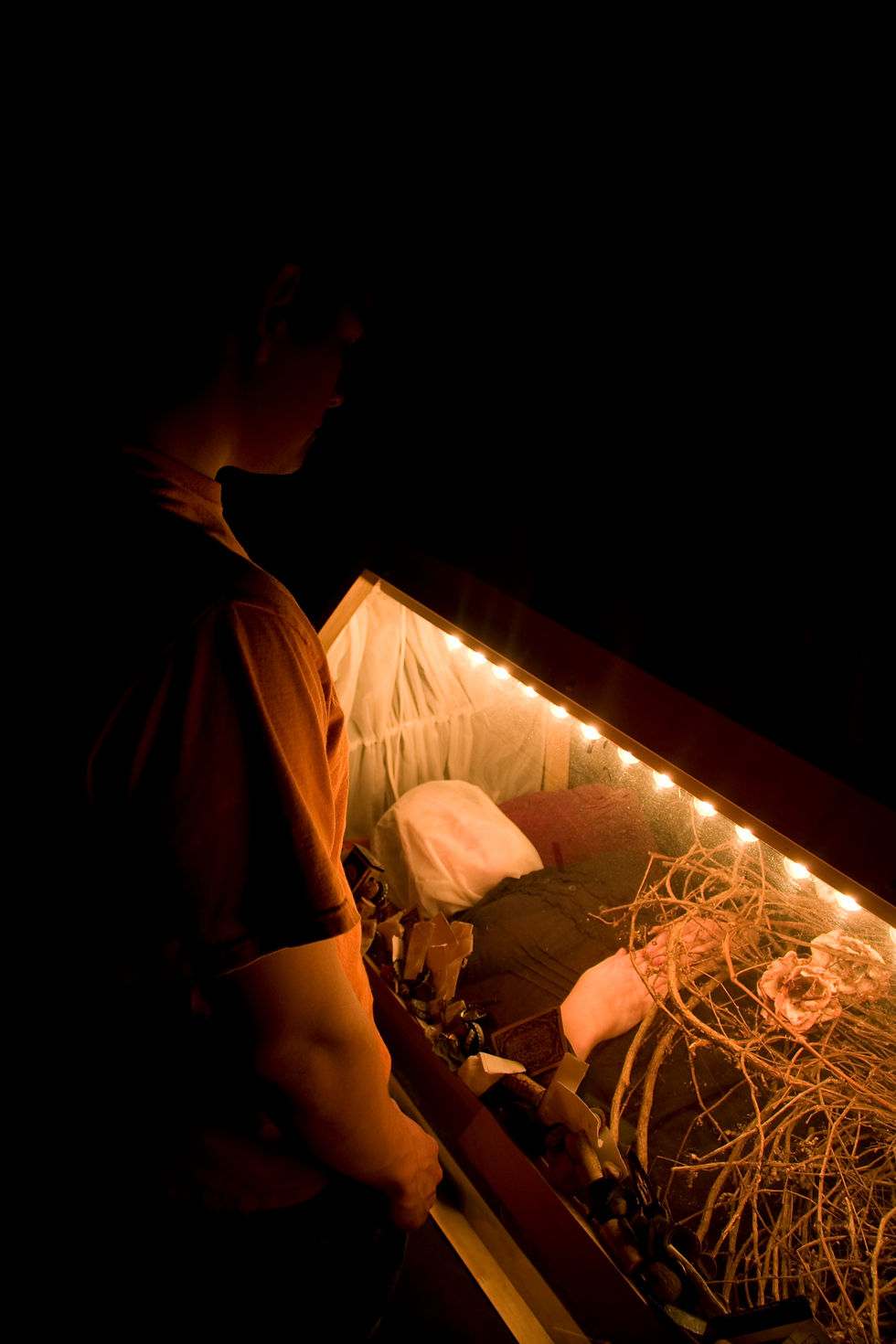
Viewers are asked to kneel in front of the casket, while the artist is lying inside with her eyes closed. Upon kneeling, her eyes open and stare directly at the viewer. The lights on the casket come on and are dimmed and illuminated in the rhythm of the artist’s breathing until the viewer stands up.
This work was created in response to the Sainte Roseline of France as part of an ongoing research on saintly remains as active and living depositories of prayer (a continuity of human-made-object confessionals in the series, 'alternatives to the talking-cure'.)
ABOUT the SAINT:
Born at the chateau of Les Arcs on 27 January, 1263, Roseline was the eldest daughter of the Arnaud de Villeneuve, wealthy landlord and mayor of Les Arcs sur Argens .
She was a very generous child, contrary to the acquisitive spirit of her family, and secretly distributed food from the chateau reserves to the local poor people.
One day her father caught her sneaking out with her apron full of bread. When she was forced to open her apron to reveal its contents, the bread miraculously turned to rose petals and blew away - the Miracle of the Roses. The next day, she entered the convent and eventually became Abbess of the Chartreuse de La Celle Roubaud.
Roseline died on 17 January, 1329 at the age of 66. Five years later she was exhumed and discovered to be entirely intact, her eyes open and perfectly clear. The Bishop of Digne was so struck by the beauty of her eyes, they were removed from her body and placed in a separate reliquary. Her body still lies in a glass case, otherwise in tact at her Chapel in Les Arcs.
Over the last 600 years, countless votaries have reported praying to the body of Sainte Roseline, only to see her eyes open and look at them in quiet acknowledgement of each prayer.


Reenactments
in collaboration with Meredith Zielke
Hosted by The International Museum of Surgical Science
Work 1: I am seepage and tender and spread
(video installation: 15 minutes)
from a re-staging and reenactment of two medical illustration from the museum’s archive (a small detail of a 19th century painted depiction of gynecological surgery.
Work 2: This is all I can offer
(video installation: 5 hours)
from a re-staging and reenactment of a medical illustration from the museum’s archive (19th century spinal traction device.


The Ink Well
Hosted by The Jane Addams Hull House Museum
Performance duration: 2 hours
This work addresses Jane Addams’ use of contextually masculine-attributed forms of agency - writing, public speaking and publication - to achieve an agenda associated with then-feminine priorities of the time: poverty, civil and cultural liberties, education and childcare (context: mid-19th century America).
During the performance, while connected to an electric breast pump, the artist sat in front of a portrait of Jane Addams and wrote an improvised and continuous letter detailing the ways in which the artist strives to connect to the reality of Addams' commitments, her sacrifices, and her determination in an effort to introduce the same level of investment and resolve in her own life.
(While engaged in research at the Jane Addams Hull House Museum, during the 3 month residency, the artist attempted to induce lactation by employing an electric breast pump for 15 minutes, 6 times a day. She consulted with several midwives - but to no avail. The milk did not come. Only ink.)


Restoration
with the accompaniment of Juliana Pivato; and assistance by Amber Ginsburg and Briana Schweizer
Hosted by the Chicago Cultural Center
Over the course of one month, the artist spent 24 hours at the Pilgrim Baptist Church in Chicago’s South Side. The structure suffered a catastrophic fire in 2006; only the stone and brick façade remains. The artist treated the architecture as though it were a person in a state of severe suffering, consoling with words and treating it with compassionate touch while wearing white archiving gloves to collect residue from the fire and environment.
A public performance was then conducted on the stairs of the Chicago Cultural Center in which the artist washed each glove while collaborator Juliana Pivato sang a gospel song, "Peace in the Valley", written by Thomas Andrew Dorsey (the music director of Pilgrim Baptist, and credited as the originator the Gospel music genre); it was sung repeatedly throughout the performance while educational leaflets were distributed and donations for the Restoration Fund were collected.


Cursory Monuments
Memorializing Chicago’s Disasters -
A performative and participative guided tour memorializing Chicago's history of disaster.
Hosted by The Chicago Cultural Center and
The Synesthetic Plan of Chicago
This project sends viewers on a pilgrimage throughout the city to sites of local tragedy, offering the history of the urban area and inviting an act of acknowledgment for the casualties and aftermath of each incident. Visitors may pick up a map at the exhibition which includes directions to each site, as well as the story behind its importance. Also included are small offerings to leave behind at each location in order to mark the loss incurred by each event.
This project was accompanied by a parallel focus on the Great Fire of Chicago, wherein the artist performed a vigil walk for each of the days of the great fire to collected dirt from city sites affected and collected them in reliquaries with the conviction that matter retains memories of events and contains material intelligence of the happenings to which it bears witness.


The Work
A collaborative performance with James Kubie; and with the assistance of 6 other performers.
Hosted by The International Museum of Surgical Science
Performance duration: 3 hours
This interactive performance involved two stations: mending and archiving.
The Act:
-
Viewers were taught, one by one, traditional suturing on slit grapefruit slices.
-
Viewers were asked to speak their medical history into the slice of fruit while mending it.
-
Slices were placed in the open mouth of the seated artist.
-
Sutures were ripped out through the teeth.
-
Juice was pressed out by the artist's tongue and swallowed.
-
Remaining pulp was removed and exhibited next to the corresponding sutures as specimen, and an alternative form of medical record of each viewer.
This interactive performance examines the personal history of woundedness. It lends each person the new ability to mend any recollection of pain attached to the experience or witnessing of physical injury. By learning the traditional, and now symbolic skill of suturing, the participants are given a new insight into medical technique, and are included in an act of healing. The flesh of this newly mended fruit, now imbued with the memory of brokenness, is consumed in order to release that history. The performer relies upon her body to digest and release any articulated trauma.


